

History of Methane Regulation
Methane, long known as a potent greenhouse gas (GHG), has lagged behind other chemicals in its attention and regulation—especially in the United States. As can be expected, a web of local, state, and federal agencies are responsible for creating and upholding pollution standards. Tracing redundancies or gaps in these standards can be a difficult task, and when it comes to methane, rules cross into the oversight of agencies like the Bureau of Land Management (BLM)/Department of the Interior, the Environmental Protection Agency (EPA), the Department of Energy, the Department of Transportation, and state-level pollution boards, such as California’s Air Resource Board (CARB), among others.

In 2009, following the Supreme Court’s Massachusetts v. EPA decision, EPA published the Endangerment Finding—determining that six greenhouse gases (including methane) endanger public health and welfare. This finding established the legal foundation for federal GHG regulation, including vehicle emissions standards, power plant rules, and the OOOOb/c methane standards.
On July 29, 2025, EPA proposed to rescind the Endangerment Finding, arguing the Clean Air Act does not authorize regulation based on global climate concerns. If finalized, this could fundamentally reshape federal greenhouse gas regulation—though state regulations, ESG commitments, and market demands for low-emissions energy would continue to drive methane monitoring regardless of federal policy.
In 2014, Colorado approved the nation’s first state-level energy sector-related regulations for methane emissions. Since then, a number of states followed suit in moving to regulate this GHG pollutant. With the latest Federal rules, every state is required to “embrace the change”.
In 2016, BLM issued the first federal Methane Waste Prevention Rule, establishing requirements to reduce venting, flaring, and leaks from oil and gas operations on federal and tribal lands. The rule faced legal challenges and revisions during the first Trump Administration.
In April 2024, BLM finalized a new Waste Prevention Rule updating requirements for gas capture, leak detection, and flare metering. However, in September 2024, a federal court blocked enforcement in five states. Under the second Trump Administration, Interior Secretary Doug Burgum ordered a review of the rule, and in December 2025, BLM delayed enforcement of certain compliance deadlines until December 2026. Operators should monitor developments through the Harvard EELP BLM Tracker.
BIL and IRA: Implementation and Evolution
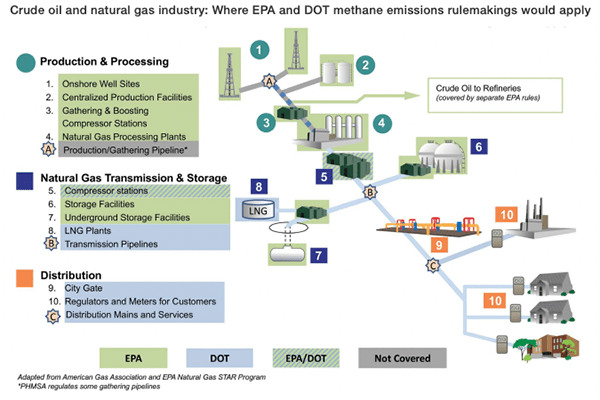
The Bipartisan Infrastructure Law and Inflation Reduction Act provided new funding and compliance requirements for methane management. However, the regulatory landscape has shifted significantly since 2022.
The Methane Emissions Reduction Program continues to provide financial and technical assistance for emissions reduction. However, the Waste Emissions Charge implementing rule was repealed via the Congressional Review Act in March 2025—companies are no longer required to pay methane fees. Compliance deadlines for OOOOb/c rules have also been extended by 18 months.
Despite federal regulatory shifts, the business case for methane monitoring remains strong. State regulations continue to require emissions management. ESG commitments, investor expectations, and market demand for low-emissions gas all drive monitoring needs. And methane leaks represent lost product—monitoring pays for itself.
Renting methane monitoring equipment offers turn-key solutions with technical support, regardless of where regulations head next.
Regulatory Shifts Under the Trump Administration (2025)
The regulatory landscape shifted significantly in 2025. In March, the EPA’s Waste Emissions Charge implementing rule was repealed via the Congressional Review Act (P.L. 119-2), signed by President Trump on March 14, 2025. While the underlying IRA statutory authority remains, EPA cannot reissue a substantially similar rule without new congressional authorization. Companies are no longer required to pay methane fees, though the statute itself has not been repealed.
In July 2025, EPA issued an interim final rule extending compliance deadlines for the 2024 OOOOb/c rules by 18 months. This affects requirements for control devices, equipment leaks, storage vessels, process controllers, and closed vent systems. The super-emitter program implementation and state plan submission deadlines were also extended. A final rule in November 2025 made these extensions permanent, with EPA estimating $750 million in compliance cost savings over 11 years.
Perhaps most significantly, in August 2025, EPA proposed to rescind the 2009 Endangerment Finding—the scientific and legal foundation for regulating greenhouse gases under the Clean Air Act. If finalized, this could fundamentally reshape federal GHG regulation. Additionally, EPA proposed delaying Subpart W GHG reporting requirements until 2034.
Further Reading
- JPL Study Identifies Methane Super-Emitters
- Colorado Leads Methane Emissions Regulation
- Bloomberg: Pennsylvania Nears New Methane Rule Approval
- 2009 EPA Endangerment Finding
- EPA Transportation Accomplishments
- EPA Light Duty Vehicle Standards
- BLM Methane and Waste Prevention Rule
- Nat Law Review: EPA Proposes New Methane Regulations
- 2016 EPA New Source Performance Standards
- U.S. Methane Emissions Reduction Action Plan
- Harvard EELP Regulatory Tracker: Waste Prevention Rule
- EPA 2025 Interim Final Rule: https://www.epa.gov/controlling-air-pollution-oil-and-natural-gas-operations/2025-interim-final-rule-extend-compliance
- EPA Waste Emissions Charge page: https://www.epa.gov/inflation-reduction-act/waste-emissions-charge
- Harvard EELP Tracker: https://eelp.law.harvard.edu/tracker/epa-voc-and-methane-standards-for-oil-and-gas-facilities-2/
Last updated: 8 January 2026 JM


